
HBOT Conversations:
Elena Schertz & Tom Fox (Part 3) – Heart Disease
Elena Schetz, NP is the nurse practitioner, and Tom Fox is the Safety Director at Extivita-RTP. Extivita-RTP offers a positive environment for healing, and they encourage anyone seeking a better quality of life to come visit them and experience for themselves the wonder of Hyperbaric Oxygen Therapy.
Watch the Podcast
In a Special 5-part series with Extivita’s Nurse Practitioner, Elena Schertz, and Safety Director, Tom Fox, we dive into the extraordinary powers of HBOT, and the healing they have witnessed for a variety of conditions. The following segments preluding are as follows:
Part 1 – HBOT for PTSD (veteran focus)
Part 2 – Concussions & HBOT
In Part 3 of 5, we discuss heart disease and how HBOT can help. Tom explains that one of the first cardiac patients he treated with HBOT was a necrosing cardiac surgical patient who had a necrosing sternum. The patient’s sternum was black before treatment, and after it was a fuchsia from the returned blood flow! The cardiac surgeon’s face was priceless as he witness this patient have such an incredible response to HBOT.
Tom states, “I think a lot of the physicians that are out there today, their reason why they haven’t considered hyperbarics is because they haven’t been exposed to it. If they were exposed and they could see what it was capable of doing, it would make the difference.”
Elena informs our host that she hasn’t had anyone come to Extivita to receive HBOT specifically for heart disease, but she has witnessed patients who were getting treated for other conditions benefit from HBOT for heart health. This is known through ejection fraction measurement, as Elena describes…
“I could say from about three people who have have reported improved ejection fraction from doing hyperbarics alone.”
di Girolamo reflects on a story where he heard from two HBOT patients in their late 60s, who had less than 50% heart function. They started to use hyperbarics for other reasons, and discovered that after 28 HBOT treatments they now had 70% heart function. When the Cardiologist asked with amazement, “What did you do?!”, they said we didn’t do anything — just HBOT diving.
The topic of myocarditis arises, and how HBOT can help. Myocarditis is inflammation around the heart, and in this case, hyperbaric oxygen therapy could have an intimate role in bringing about improvement to the condition. Tom continues to explain how people want to see studies, but most of the studies out there on HBOT are simply not good.
There’s never been a lot of studies about hyperbarics, and the structure of the studies comes into question. Because when we look at the hyperbaric studies that are out there, you look and see that they’re always comparing hyperbarics to slightly pressurized room air. You’ll see that traditionally how they write it up and it could be cerebral palsy, it could be post-traumatic stress disorder, the same write up, just replace the words. Both groups improved from baseline. However, there was no differentiation between the groups.
Tom goes into a discussion about a PhD student at the University of Wisconsin who went the extra mile and looked at the therapeutic effects of hyperbaric air – hyperbaric air at 1.3, slightly pressurized room air. And what he was able to do is document mobilization of stem cells. By doing so, that encouraged the medical community to rethink hyperbaric studies using hyperbaric air as the “control”.
Tom continues to dive into HBOT and heart health in general….
“Just by basis of how hyperbarics works, you can see why that did work, how that was very helpful for these folks who had myocardial infarctions. So with with the re-oxygenation of the heart, with the stem cell mobilization, with growth of new blood vessels, you could see how the heart does start to basically regenerate and get better and heal.”
When your heart is damaged from a heart attack, it’s like a wound in one of your organs or muscle. Hyperbarics is known to be incredibly beneficial for wound care, 1500 hospitals across our nation have HBOT chambers that are used often simply for wound care. So, if hypoxia and the inflammation resulting from a cardiac event is causing damage to the heart, hyperbaric oxygen therapy will work to naturally resolve and remove those two things. di Girolamo stresses that you don’t have to be an expert in HBOT to understand this, and if he had a bad heart he’d most certainly be getting hyperbaric treatments, and encourages you to do the same.
They mention that if you were to have a heart attack, inside a hyperbaric chamber is exactly where you’d want to be so you’re supersaturated with oxygen. This leads into the reasons why it’s important to pre-condition your body with oxygen prior to heart surgery, or really even any surgery. Tom references a study, “Research report: the effects of hyperbaric oxygen preconditioning on myocardial biomarkers of cardioprotection in patients having coronary artery bypass graft surgery” and explains that prepping your body for surgery can be critical in achieving a better outcome.
Tom explains, “The number one complication out of cardiac bypass surgery is post-cardiac surgical stroke. If you can actually precondition, you can avoid this.”
Cost savings and money for health and wellness remains a hot topic. Tom educates us that one of the chief things that has always been identified with how health care is practiced in the United States and Canada is it’s a for-profit industry. But, if we looked at reinstituting a payment process that actually rewarded people for being healthy, managing patients, and avoiding conditions, then we could transition the current medical industrial to be incentivized to make people healthier. If there was a way to ever do that, using hyperbaric oxygen therapy as one of the key treatments would surely be a huge leap in the right direction.
Guests

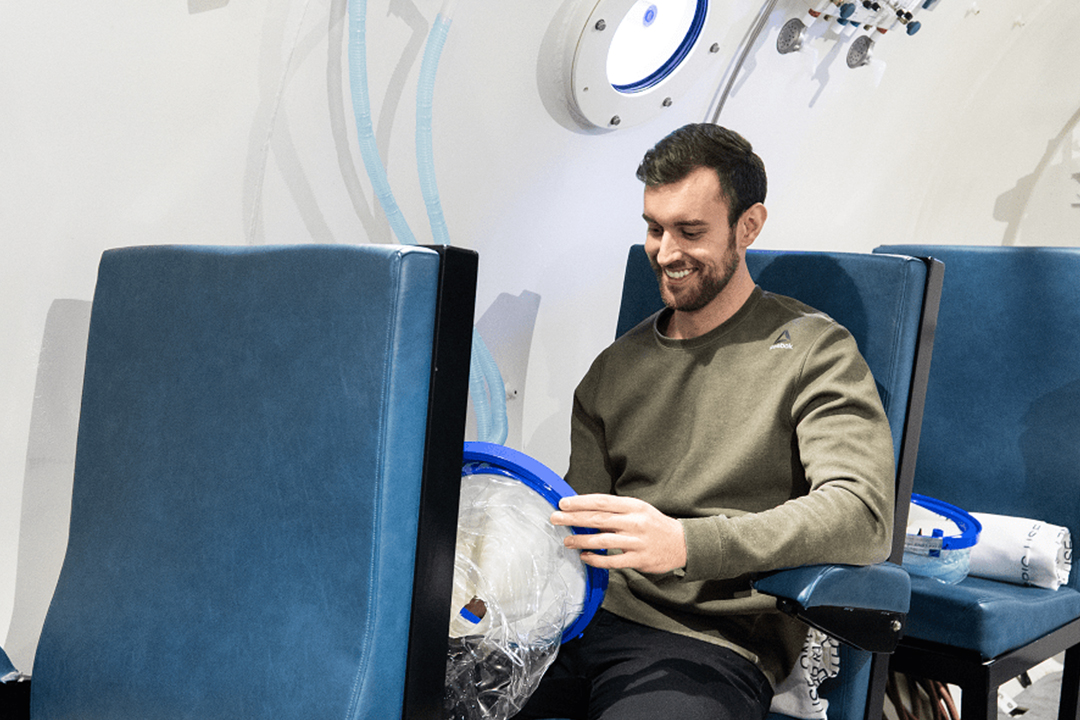
Elena Schertz, NP - Clinic Manager at Extivita RTP
Elena worked as a nurse in the pediatric oncology, cardiac, and surgical units at UNC hospitals for 15 years before deciding to work in integrative medicine. After years of working as a nurse, she decided to pursue her graduate degree, completing her masters with honors. She is board certified as a Family Nurse Practitioner (FNP) through the American Nurses Credentialing Center.
Elena’s passion for integrative medicine comes from her knowledge that the mind, body and psych/social/spiritual systems are not separate. The focus of Elena’s practice is to approach each of her patient’s healing process from the perspective of the whole, supported and grounded in safety and evidence-based medicine. She also maintains close consultative relationships with experts in the field to promote and enhance wellness for her patients. Elena joined the wonderful Extivita team in March 2019 and is thrilled to be a part of advancing health and wellness through hyperbaric medicine.
Thomas M. Fox, MAS,MS, CHT - Safety Director at Extivita RTP
Tom joined the Extivita team in 2022 as the Safety Director, helping Extivita to maintain a healthy and safe environment for exceptional patient care.
Extivita-RTP – Hyperbaric Oxygen Therapy Clinic
2012-D TW Alexander Drive
Durham, NC 27709
919-354-3775
919-354-3776
contact@extivita.org
https://www.extivita.org/
Subscribe Now, It’s Free!
Recent HBOT News
Clinical Trial – Hyperbaric Oxygen for Carbon Monoxide Induced Chronic Encephalopathy
in some patients, a few days or weeks after they recover from carbon monoxide poisoning they
develop new symptoms. These can affect mood, ability to think or remember clearly, and
movements. Some people develop movement problems that are similar to Parkinson’s disease.
This damage to brain tissue is called "encephalopathy," and this study will look at the
effect of pressurized oxygen therapy on long term, or chronic, encephalopathy.
A new treatment could benefit vets with PTSD and brain injury, lawmakers want insurers to reimburse for it
Through the use of hyperbaric, oxygen-rich chambers, medical researchers have found a way to restore a significant amount of neurological function in brain tissue thought to be chronically damaged by stroke, traumatic injury, and metabolic disorder — even years after
Clinical Trial – Plethysmographic Variability Index in Post Spinal Anesthesia Hypotension in Cesarean Section
– Full term pregnant female patients presented for elective C.S for single viable fetus
will be included in this study.
– Before anesthesia, the patient will be attached to a monitor of: ECG , heart rate, non
invasive blood pressure, pulse taximeter applied on the index finger of the limb not
attached to the blood pressure cuff, pulse oximetry and plethysmographic variability
index (PVI) and perfusion index (PI) will be taken by (Massimo radical 7, Massimo corp.
USA). Measures will be recorded every 5 minutes preoperative.
– Patients with PVI <15 will be excluded from the study.
- Patients with PVI > 15 are started on intravenous infusion of warm ringer lactate
solution via suitable pore intravenous cannula to reach target of PVI <15 or a total 1
liter of ringer lactate.
- The patients in which the PVI is corrected by fluid to level below 15 will be Group (C)
or corrected group. Patients in which intravenous fluid administration did not result
any change in PVI or changed but still higher than 15 will be Group (NC) or non
corrected group.
After preoperative preparation patient is shifted to operating theater, with all monitors
applied. She will receive spinal block at lumbar 3-4 space with hyperbaric bupivacaine 8 mg
plus 25 mic fentanyl. After giving anesthesia and positioning for surgery with a left lateral
tilt of 15 degrees,