
HBOT Conversations:
Elena Schertz & Tom Fox (Part 4) – Cancer & Cerebral Palsy
Elena Schetz, NP is the nurse practitioner, and Tom Fox is the Safety Director at Extivita-RTP. Extivita-RTP offers a positive environment for healing, and they encourage anyone seeking a better quality of life to come visit them and experience for themselves the wonder of Hyperbaric Oxygen Therapy.
Watch the Podcast
In a Special 5-part series with Extivita’s Nurse Practitioner, Elena Schertz, and Safety Director, Tom Fox, we dive into the extraordinary powers of HBOT, and the healing they have witnessed for a variety of conditions. The following segments prelude this episode:
Part 1 – HBOT for PTSD (veteran focus)
Part 2 – Concussions & HBOT
Part 3 – Heart Disease & HBOT
In Part 4 of 5, we discuss two topics — cancer & cerebral palsy.
Let’s start with cancer. Elena Schertz says cancer patients have come through the doors at Extivita many times, looking for a “Hail Mary”. They’ve done the chemo and radiation and they are now at the end of their rope, and don’t know what else to do. Elena believes that when it comes to cancer you should throw everything at it, monotherapy is not the answer. In the end, does it really matter which therapy worked?! As long as it works!! She will often discuss diet changes and recommend IV therapies like high dose vitamin C, Pulse Electromagnetic Therapy (PEMF – BEMER) along with Hyperbaric Oxygen Therapy. Elena explains that she’s seen impressive results using pro-oxidative treatments to help the patient kill cancer.
“I’ve seen patients who have reported to me that they have had their the tumor size shrink during the course of maybe 20 sessions.”
Elena reminds viewers that radiation necrosis is one of the covered indications by the FDA, so treatment is typically reimbursed by insurance. Since radiation kills the bad cells, and the good, hyperbarics can help the patient recover from radiation therapy by restoring oxygen to the good cells that were damaged in radiation field. HBOT can also be used in conjunction with chemotherapy to ease chemotherapy side effects (especially brain fog).
Tom explains that he has seen patients gain improvement in their biomarkers for cancer as a direct effect of receiving HBOT. And he has seen patients come in with brain cancer and glioblastoma, that were given nine months or three months to live. One particular patient comes to mind who Tom treated with HBOT and is now living 2 years post diagnosis and was only given months to live; HBOT was one of many therapies the patient has been using. It’s important to understand that its the incorporation of Hyperbaric Oxygen Therapy that makes the tumor happy. Happy tumors are calm, while aggravated tumors grow. By giving the tumor oxygen under pressure, it interrupts the metabolism of the tumor. He further explains that typically the inside of a tumor is hypoxic (oxygen starved) so by adding oxygen to the tumor, it will counteract the growth of the tumor.
Tom explains that it’s important to understand the role of oxygen in healing, and he recommends the Flexner Report to those who want to know more on medical education and emphasizing the science.
Tom says he would tell doctors & healers, “Hey, listen, practice your art. Practice the art of healing. Use every tool available to you and you’ll see outcome, especially when you use and look at the role of oxygen in healing.”
In turn, host, Edward di Girolamo, pointed out that the Research Rundowns by HBOT News are great for better understanding the research behind HBOT in particular, because we try and point out if there’s a conflict of interest to the researchers and to the viewers/readers.
“There’s a lot of good science out there and it’s just being ignored or when it’s summarized by somebody that may be paid off because of a conflict of interest, they conclude something that’s completely inaccurate, and that’s what we try to point out in our Research Rundowns.”
This leads into a brief discussion on Cerebral Palsy and universal healthcare, as Tom highlights some research that falls right in line with what Edward mentioned. Tom tells his personal story about his two step-sons who were born with Cerebral Palsy and how Hyperbarics helped them tremendously in gaining a better quality of life.
The CP twins started receiving treatment at age 4. One never went back to a wheelchair after 24 HBOT treatments, while the other (who was more severely affected by CP) gained truck control and was now feeding himself. Today, at 27 years old, they have both had well over 1,500 HBOT treatments. One graduated from college and the other works in community awareness and teaches English as a second language.
Tom ponders whether cerebral palsy could be eliminated if a child is treated with HBOT extremely early in life, would it repair the oxygen deprived damage done to the brain at birth? He says there are many physicians who think it would, and would ease the impact of CP on medicine and society.
Guests

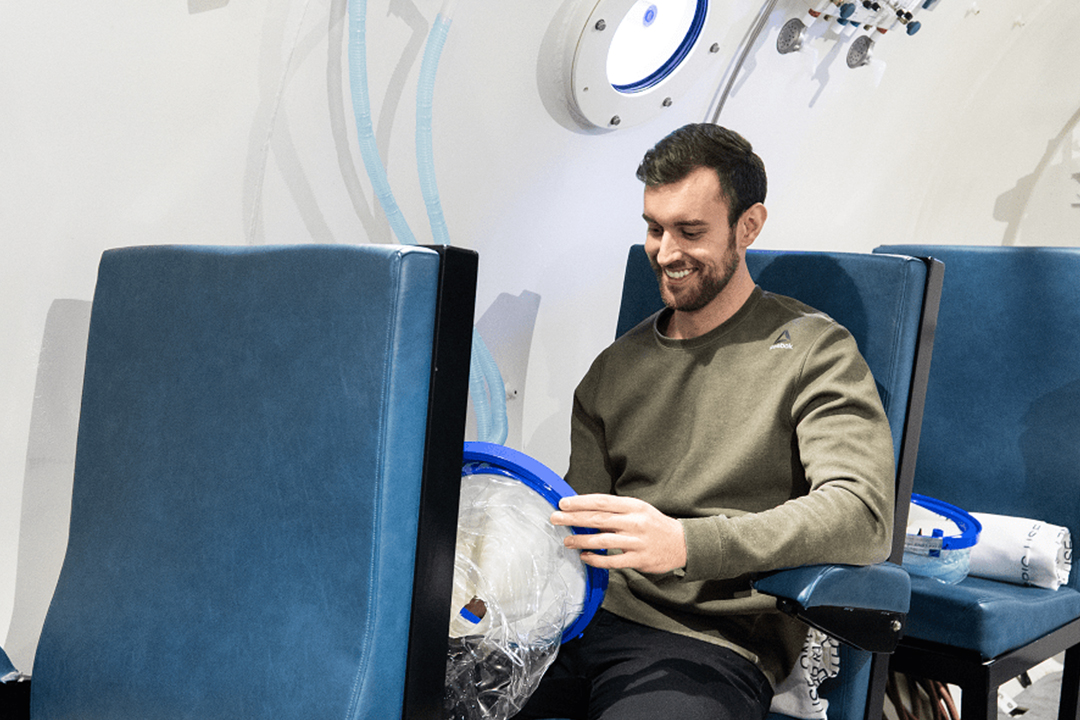
Elena Schertz, NP - Clinic Manager at Extivita RTP
Elena worked as a nurse in the pediatric oncology, cardiac, and surgical units at UNC hospitals for 15 years before deciding to work in integrative medicine. After years of working as a nurse, she decided to pursue her graduate degree, completing her masters with honors. She is board certified as a Family Nurse Practitioner (FNP) through the American Nurses Credentialing Center.
Elena’s passion for integrative medicine comes from her knowledge that the mind, body and psych/social/spiritual systems are not separate. The focus of Elena’s practice is to approach each of her patient’s healing process from the perspective of the whole, supported and grounded in safety and evidence-based medicine. She also maintains close consultative relationships with experts in the field to promote and enhance wellness for her patients. Elena joined the wonderful Extivita team in March 2019 and is thrilled to be a part of advancing health and wellness through hyperbaric medicine.
Thomas M. Fox, MAS,MS, CHT - Safety Director at Extivita RTP
Tom joined the Extivita team in 2022 as the Safety Director, helping Extivita to maintain a healthy and safe environment for exceptional patient care.
Extivita-RTP – Hyperbaric Oxygen Therapy Clinic
2012-D TW Alexander Drive
Durham, NC 27709
919-354-3775
919-354-3776
contact@extivita.org
https://www.extivita.org/
Subscribe Now, It’s Free!
Recent HBOT News
Clinical Trial – Intrathecal Neostigmine for Prevention of PDPH
Neuraxial blocks continue to be the cornerstone of anesthesia and postoperative analgesia for
normal vaginal delivery and elective caesarean section due to its approved safety and
efficiency for decades. Post-dural puncture headache (PDPH) is still one of the most common
complications of neuraxial anesthetic techniques. The headache could be severe and limit the
activities of the new mother to care for her baby, prolong hospital stay.
PDPH is defined as a headache that develops within five days of dural puncture and can’t be
attributed to any other types of headache and mostly is postural in character.
Neostigmine methylsulfate is a synthetic carbamic acid ester which reversibly inhibits the
enzyme Acetylcholine esterase (AChE) that makes more Acetylcholine molecules available at
cholinergic receptors. Neostigmine is used in anesthesia mainly as a reversal for
non-depolarizing neuromuscular agents.
Intrathecal (IT) neostigmine was tried as an adjuvant to local anesthetics in IT block for
elective cesarean sections to decrease local anesthetic consumption and to prolong
postoperative analgesia. Side effects of IT neostigmine are dose-dependent with doses more
than 25 µg especially nausea and vomiting and could be decreased by increasing the baricities
of the local anesthetic solutions and by early head up position after IT injection. However,
its effect on PDPH was not investigated before in literature.
Parturients will be randomly assigned into one of two groups: the intervention group will
receive 20 µg with IT Bupivacaine and the control group will receive an equivalent volume of
dextrose 5% with the IT Bupivacaine.
The objective of the current study is to evaluate the efficacy and safety of IT neostigmine
as an adjuvant to bupivacaine in reducing the incidence and severity of post-dural puncture
headache in parturients scheduled for an elective cesarean section.
Evidence brief: hyperbaric oxygen therapy (HBOT) for traumatic brain injury and/or post-traumatic stress disorder.
This report is a product of the VA Evidence-based Synthesis Program. The purpose is to provide “timely and accurate syntheses of targeted healthcare topics. to improve the health and healthcare of Veterans”. The authors have made a comprehensive search and analysis of the literature and make recommendations to assist clinicians in dealing with veterans suffering from either traumatic brain injury (TBI) or post-traumatic stress disorder (PTSD). The report is timely and of great potential impact given the vigorous and lengthy debate among hyperbaric physicians and lay people determined to find an answer for the large numbers of veterans deeply affected with some combination of PTSD and post-concussion dysfunction.
Clinical Trial – Hyperbaric Oxygen Therapy in Children With Inflammatory Bowel Diseases
The study assesses the effectiveness of hyperbaric oxygen therapy in the treatment of
inflammatory bowel disease in children.