
HBOT Conversations:
Laurie Anderson (Part 3)
Healing COVID with HBOT
Dr. Laurie is a Doctor of Pharmacy, and a graduate of the University of North Carolina – Chapel Hill (UNC-CH) School of Pharmacy and the Pharmacy Practice Residency Program at the University of California – San Francisco (UCSF). Dr. Laurie spent many years in clinical practice, first as a neurosurgery clinical pharmacist at UCSF Medical Center and then as a general medicine and critical care clinical pharmacist at Duke Medical Center. For the past 14 years Dr. Laurie has been working in industry, and is currently a safety scientist in early phase drug development, designing safety strategies for First Time in Human clinical trials.
Through her own journey navigating chronic illness, Dr. Laurie has explored and embraced many forms of alternative and non-traditional medicine to support her body for healing. She has gravitated towards practitioners and modalities that treat the whole patient, with the mantra that tending to mind, body and spirit is the true key to lasting health. Over the years, Dr. Laurie has discovered that this often leads to a ‘less is more’ approach. She discovered HBOT when she was struggling to heal from COVID, and now tells anyone who will listen about the power of oxygen and pressure.
Watch the Podcast
We continue Dr. Laurie Anderson’s HBOT News Network interview, diving in deeper to discuss our veteran population, does HBOT have a therapeutic index, and what is the research telling us about the HBOT industry.
Her interview has been released as a three part series. Part 1 and Part 2 has already been released with both focusing on her HBOT journey with COVID & Lyme Disease.
In Part 3 of Laurie’s podcast the conversation shifts. It starts with the medical industry and the unfortunate “bad rap” that Hyperbaric Oxygen sometimes receives. Dr, Laurie refers to HBOT as a gift, so it’s truly unfortunate when the media focuses on the negative instead of the positive, influencing the public to not even try this life saving therapy. Research trials are discussed, including the problems that the hyperbaric industry has identified in the sham, placebo and/or control group when researchers try to mimic HBOT with little pressure and they discover that everyone starts to improve. Those of us in this industry understand and effortlessly work to enlighten others that any amount of pressure is good and therapeutic.
The topic of our US military and the high rate of suicide among our service man and women arises. Is there a solution to the veteran suicide epidemic our country is facing? It appears there is. di Girolamo speaks of Patriot Hyperbarics in Tulsa, and the success they have had treating veterans with Hyperbaric Oxygen Therapy.
“The Patriot Clinics in Tulsa treated some 500 veterans with PTSD, with donated money, donated chambers, and healed them. Most of them war-fighters, were in a bedroom, locked in the dark for years and years, like seven, ten years. And then they found Patriot Clinics and they got 40 treatments and then they got their executive function back. Some of them starting businesses. I saw videos of guys, you know, in the car on their way to the clinic on the first day and then on the 40th day, talking about their experience, it was just amazing.
There wasn’t some combined study about that. 500 souls were saved that didn’t commit suicide, they worked their way out of it.”
Dr. Laurie, who is a Doctor of Pharmacy, brings up an excellent point, and one that we’ve never discussed before on HBOT News. We know that the FDA ultimately states that oxygen is a drug, and you are required to have a prescription for it. But does Hyperbaric Oxygen have a therapeutic index like other drugs? And if so… how would a patient know they have reached the therapeutic index and how long is a patient at the therapeutic index? She explains it like this…
“If I apply this to drugs, like with a drug we would want to keep the level, generally, we try to keep the level of a drug in the blood inside the therapeutic index, right? So sometimes, depending on the half life of the drug, you can be in your therapeutic index by taking it once a day so you trickle up and down in between that therapeutic index. Some drugs have a shorter half life and you have to take it twice a day to stay in that therapeutic index.
So what keeps you in whatever is the defined therapeutic index, if that can be translated to oxygen therapy, you know, is it daily? Is it twice a day?”
di Girolamo wonders if in 20 years from now the industry will look back on this conversation and be shocked that we weren’t more focused on the therapeutic index. He stresses that the hyperbaric industry can’t even come together and decide the specific definition of hyperbaric oxygen, much less all these variables that Dr. Laurie has opened our eyes to.
Dr. Laurie ends her time here with HBOT News stressing that for her HBOT healed her during a very sick time with COVID, and it helped her with many of the Lyme Disease symptoms she struggled with for years. It worked for her, and she said it’s definitely worth a try to see if it can work for you.
Guests

Dr. Laurie Anderson, Pharm.D.
Through her own journey navigating chronic illness, Dr. Laurie has explored and embraced many forms of alternative and non-traditional medicine to support her body for healing. She has gravitated towards practitioners and modalities that treat the whole patient, with the mantra that tending to mind, body and spirit is the true key to lasting health. Over the years, Dr. Laurie has discovered that this often leads to a ‘less is more’ approach.
When not working, Dr. Laurie is an avid gardener, ballroom dancer and traveler with her husband. Remaining curious and finding joy in every day are her super powers.
Subscribe Now, It’s Free!
Recent HBOT News
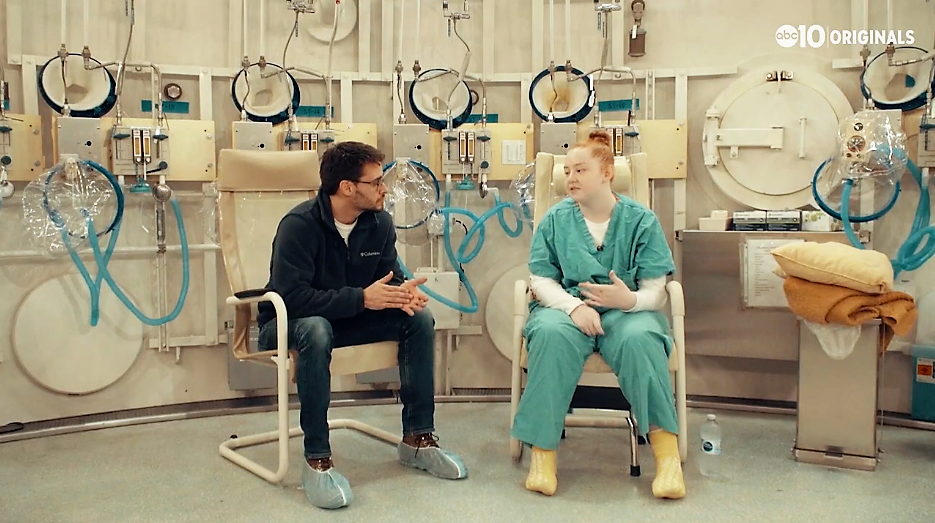
Healing under pressure: Inside a military hyperbaric chamber
At 16, she had a stroke. At 17, her town burned in the Camp Fire. Now, as her community rebuilds, she's healing thanks to hyperbaric therapy. SACRAMENTO, Calif — February 2, 2017, started off as an ordinary day for the Pipkin Family. Patrick and Stacey Pipkin just...
Clinical Trial – High-flow Oxygen for Vaso-occlusive Pain Crisis
Sickle cell disease (SCD) is characterized by recurrent vaso-occlusive pain crisis (VOC),
which may evolve to acute chest syndrome (ACS), the most common cause of death among adult
patients with SCD. Currently, there is no safe and effective treatment to abort VOC or
prevent secondary ACS. Management of VOC mostly involve a symptomatic approach including
hydration, analgesics, transfusion, and incentive spirometry, which was investigated in a
very limited number of patients (<30).
The polymerisation of HbS is one major feature in the pathogenesis of vaso-occlusion. Among
factors determining the rate and extent of HbS polymer formation, the hypoxic stimulus is one
of the most potent and readily alterable. Current guidelines recommend oxygen therapy in
patients with VOC in order to maintain a target oxygen saturation of 95%. Low-flow nasal
oxygen (LFNO) is routinely used to achieve this normoxia approach, particularly in patients
at risk of secondary ACS because they may experience acute desaturation. In contrast, various
case series suggest a potential beneficial role of intensified oxygen therapy targeting
hyperoxia for the management of VOC, particularly with the use of hyperbaric oxygen, but the
latter is difficult to implement in routine clinical practice.
A recent high-flow nasal oxygen (HFNO) technology allows the delivery of humidified gas at
high fraction of inspired oxygen (FiO2) through nasal cannula. The FiO2 can be adjusted up to
100% (allowing hyperoxia that may reverse sickling) and the flow can be increased up to 60
L/min (which generates positive airway pressure and dead space flushing, that may prevent
evolution of VOC towards ACS by alleviating atelectasis and opioid-induced hypercapnia). In
patients with acute respiratory failure, HFNO has been shown to improve patient's comfort,
oxygenation, and survival as compared to standard oxygen or non-invasive ventilation.
The aim of the present study is to test the efficacy and safety of HFNO for the management of
VOC and prevention of secondary ACS. The investigators will use a multi-arm multi-stage
(MAMS) design to achieve these goals. HFNO will be delivered through AIRVO 2 (Fisher and
Paykel Healthcare, New Zealand), a device that incorporates a turbine allowing its use in
hospital wards.
Clinical Trial – Hyperbaric Oxygen Therapy and Allogeneic Peripheral Blood Stem Cell (PBSC) Transplant
Subjects with Acute Myeloblastic Leukemia (AML) and myelodysplastic syndrome (MDS) who are
considered eligible for allogeneic stem cell transplant by the transplant team at WCI (Wilmot
Cancer Institute)will be enrolled in the study. Patients will receive Melphalan on day -2 and
HBO (Hyperbaric Oxygen) therapy on day 0 of the transplant. After neutrophil recovery is
documented, the patients will be seen in clinic at least weekly through day +100.