
HBOT Conversations:
Tom Fox (Part 1)
Tom is the Research Physiologist for the Hyperbaric Institute for Research and Training, a division of Island Hyperbaric Centre in Pincourt QC. He has worked in the field of Clinical Hyperbaric Oxygen for the last 30 years, and has been intimately involved with the implementation and the development of the US Army’s Clinical Hyperbaric Service at Dwight David Eisenhower Army Medical Center. Tom is a senior army aviator and flew twelve years as a Medical Evacuation Pilot for the US Army.
Tom joined the Extivita-RTP team in 2022 as the Safety Director, and is joining us in a 2-part series to discuss the history of Hyperbaric Oxygen Therapy and dive into his personal experience healing patients with HBOT.
Watch the Podcast
We appreciate HBOT historian, Tom Fox, returning to HBOT News to dive in deeper to the history of Hyperbarics, which we can date back to the 1660s!
Tom explains that in the 1830s, the first clinical use of hyperbarics was used and introduced, this revived Nathaniel Henshaw’s concept of Hyperbaric treatments. Nathaniel Henshaw, a clergyman, built a sealed chamber in 1662. Henshaw believed that the application of higher pressure (hyperbaria) was good to treat acute conditions, and that lower pressure (hypobaria) would be better to treat chronic diseases.
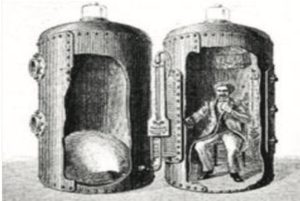
1662, Henshaw’s “Domicilium” hyperbaric chamber
This is an interesting fact, because now we’re learning that the cyclic use of hyperbaria (or relative hyperbaria) and hypobaria is very intriguing in what it’s doing from the standpoint of physiology. Tom mentions Dr. Efrati and his group of researchers have been at the forefront of looking at this, and are doing a phenominal job of conducting the hyperbaric studies and getting the hyperbaric education out there. There’s been very limited commitment to do this, he commends Dr. Efrati and his group at Tel Aviv for all they do for the HBOT industry. What you will witness throughout the history of hyperbarics is that they’ve used slightly pressurized room air, and that’s important to know because the slightly pressurized room air has consistently been assumed not to have any effect. It’s even offered up as a control in many of the studies, like the placebo. But the problem is when the placebo helps and the treatment helps, it’s easy to say that the reason both groups are getting better is because of the “participation effect”, or it being “in their heads”. And Dr. Efrati is bringing all this to light. This information is also changing the way the HBOT industry looks at the application of air breaks within the protocols. The use of air breaks was thought to fight oxygen toxicity, but now it’s used to establish a relative hypoxia without going into hypoxic conditions. Host di Girolamo then breaks all of that information down for the viewer to better understand…
So to paraphrase that, you’re breathing pure oxygen and also now you’re breathing air, your body says, ‘oh, oxygen’s depleting, you’re suffocating.’ All these mechanisms occur in your physiology, and then the body’s like, ‘Oh, no, everything’s okay. We have plenty of oxygen.’ So that five minute air break triggers that, and then he’s doing it, I think, three or four times in a 90 minute treatment and it ends up being therapeutic.
Continuing down the timeline of HBOT and fascinating discoveries in the 1800s, Tom Fox brings up a series of articles, Lectures on The Compressed Air Bath and its uses in the treatment of disease, that appeared in the British Medical Journal, dated April 18th, 1885 by a doctor, Theodore Williams. Tom reads the first paragraph from the first article:
“The use of atmospheric air under different degrees of barometric pressure in the treatment of disease is one of the most important advances in modern medicine. When we consider the simplicity of the agent, the exact method by which it is applied, and the precision with which it can be regulated to the requirements of each individual, we are astonished that in England, this method of treatment has been so little used.” – Theodore Williams
That was almost 150 years ago. Back then they were just taking air and putting you under pressure. Now it’s a breakthrough medical treatment, and it’s still not being used in the manner that it could/should be. Almost 200 years ago we were on the cutting edge of medicine! And today we still have to fight to explain that even slightly pressurized room air has a therapeutic benefit — using pressure for healing purposes has literally been happening since the 1600s.
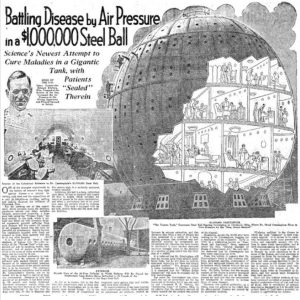 Now we approach the 1900s in the HBOT history timeline. One of the most famous (and LARGEST) chambers is discussed, the Cunningham Ball, by Dr. Cunningham. Dr. Cunningham clearly saw the benefits of Hyperbaric Oxygen Therapy and basically risked his entire career/life, and life savings to help people and prove the benefits. Doctor Cunningham was an anesthesiologist by trade, inventing circuits that are still in use and still patented by anesthesiology. In the 1918s, with the last pandemic of the Spanish Flu, Dr. Cunningham made the observation that there was a higher mortality rate when you went to Denver, as opposed to when you were at sea level, because of the pressure and oxygen changes. Ultimately a Spanish Flu patient in Denver was getting a lower dose of oxygen because of the lower air pressure. Dr. Cunningham even saved the life of one gentleman who was turning blue by simply treating with hyperbaric air. This lead to the dedication of $1M in funds to build the famous Cunningham ball, which was almost like a pressurized six story hotel that people would live in for a month or other extended periods of time.
Apparently, Cunningham had some difficulty justifying it all by scientific standards, and this was a very new concept in US medicine. The world had never seen anything like it! Unfortunately, Cunningham fell victim toa unusual amount of scrutiny, and was eventually shut down with the chamber being sold for scrap metal during World War II.
So many people now see the value in Cunningham’s efforts and what he contributed to the HBOT industry. Finally, his work can be interpreted as vindication of the God-given miracle of oxygen and pressure to heal our bodies and minds.
Guests
Thomas M. Fox, MAS,MS, CHT - Safety Director at Extivita RTP & Research Physiologist for the Hyperbaric Institute for Research and Training
Tom is the Research Physiologist for the Hyperbaric Institute for Research and Training, a division of Island Hyperbaric Centre in Pincourt QC. He has worked in the field of Clinical Hyperbaric Oxygen for the last 30 years. During this time, he has been intimately involved with the implementation and the development of the US Army’s Clinical Hyperbaric Service at Dwight David Eisenhower Army Medical Center. He has provided contract hyperbaric services since 1997. Prior to accepting his current position in Quebec, Canada, Mr. Fox served as the Chief of the Atmospherics Branch of the U.S. Army School of Aviation Medicine, Fort Rucker Alabama. In this capacity, he was responsible for hyperbaric/ hypobaric operations and training of US and NATO aviators, flight surgeons and flight medics. Mr. Fox is a senior army aviator and flew twelve years as a Medical Evacuation Pilot for the US Army.
Tom joined the Extivita team in 2022 as the Safety Director, helping Extivita to maintain a healthy and safe environment for exceptional patient care.
Subscribe Now, It’s Free!
Recent HBOT News
Growth Hormone Deficiency: Health and Longevity
Abstract The important role of GH in the control of mammalian longevity was first deduced from extended longevity of mice with genetic GH deficiency (GHD) or GH resistance. Mice with isolated GHD (IGHD) due to GHRH or GHRH receptor mutations, combined deficiency of...

Why is Justin Bieber Sleeping in a hyperbaric Oxygen Chamber?
Find out why pop star Justin Beiber has decided to sleep in a hyperbaric oxygen chamber. "Justin Bieber is testing out some futuristic healing technology. The pop star, 25, showed fans his new nighttime routine on his Instagram Stories on Sunday, passing his phone off...
Clinical Trial – The Role of Hyperbaric Oxygen and Neuropsychological Therapy in Cognitive Function Following Traumatic Brain Injury
Traumatic brain injury (TBI) caused by accidents is a very important public health problem in
Taiwan. There are many people with brain damage and cognitive dysfunction caused by traumatic
brain injury every year. Currently, there is no effective treatment for cognitive dysfunction
caused by traumatic brain injury. Evidence from clinical studies in recent years suggests
that hyperbaric oxygen therapy may be a treatment for repairing nerves after brain injury.
Many studies have shown that oxidative stress and inflammatory responses play an important
role in the pathogenesis of the central nervous system. In recent years, our research team
has shown that oxidative stress and inflammatory response are significantly associated with
the prognosis of patients with traumatic brain injury, cerebral hemorrhage, and stroke
patients. More and more evidences also show that oxidative stress and inflammatory response
play an important role in the neuropathological changes of mental cognitive sequelae after
traumatic brain injury. This injury may be gradual from the time of head trauma. This process
begins with the generation of oxidative stress and free radicals. When the cell repair and
free radical scavenging system can not effectively overcome the excessive production of free
radicals, an oxidative damage reaction will occur, causing a series of inflammatory cells and
cytokines to be activated. Studies have also shown that when inhibiting those free radicals
that produce oxidative stress, the neurological function and cognitive function of the head
after trauma can be significantly improved.
It is becoming widely acknowledged that the combined action of hyperoxia and hyperbaric
pressure leads to significant improvement in tissue oxygenation while targeting both
oxygenand pressure-sensitive genes, resulting in improved mitochondrial metabolism with
anti-apoptotic and anti-inflammatory effects. The investigators published an article this
year showing that hyperbaric oxygen therapy can improve the prognosis of patients with acute
stroke and increase endothelial progenitor cells in the systemic circulation.
The investigators plan to conduct this research project through hyperbaric oxygen therapy and
neuropsychological therapy, and using scientific tests and neurocognitive function
assessments. The investigators hope to answer the following questions: (1) Whether the
treatment of hyperbaric oxygen can improve oxidative stress and inflammatory response after
brain injury, and observe changes in biomarker concentration; (2) Whether hyperbaric oxygen
therapy and neuropsychological therapy can improve cognitive function after brain injury; and
(3) which biomarkers are factors that influence cognitive function prognosis.