
HBOT Conversations:
Tom Fox (Part 1)
Tom is the Research Physiologist for the Hyperbaric Institute for Research and Training, a division of Island Hyperbaric Centre in Pincourt QC. He has worked in the field of Clinical Hyperbaric Oxygen for the last 30 years, and has been intimately involved with the implementation and the development of the US Army’s Clinical Hyperbaric Service at Dwight David Eisenhower Army Medical Center. Tom is a senior army aviator and flew twelve years as a Medical Evacuation Pilot for the US Army.
Tom joined the Extivita-RTP team in 2022 as the Safety Director, and is joining us in a 2-part series to discuss the history of Hyperbaric Oxygen Therapy and dive into his personal experience healing patients with HBOT.
Watch the Podcast
We appreciate HBOT historian, Tom Fox, returning to HBOT News to dive in deeper to the history of Hyperbarics, which we can date back to the 1660s!
Tom explains that in the 1830s, the first clinical use of hyperbarics was used and introduced, this revived Nathaniel Henshaw’s concept of Hyperbaric treatments. Nathaniel Henshaw, a clergyman, built a sealed chamber in 1662. Henshaw believed that the application of higher pressure (hyperbaria) was good to treat acute conditions, and that lower pressure (hypobaria) would be better to treat chronic diseases.
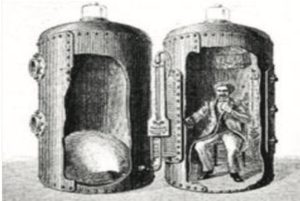
1662, Henshaw’s “Domicilium” hyperbaric chamber
This is an interesting fact, because now we’re learning that the cyclic use of hyperbaria (or relative hyperbaria) and hypobaria is very intriguing in what it’s doing from the standpoint of physiology. Tom mentions Dr. Efrati and his group of researchers have been at the forefront of looking at this, and are doing a phenominal job of conducting the hyperbaric studies and getting the hyperbaric education out there. There’s been very limited commitment to do this, he commends Dr. Efrati and his group at Tel Aviv for all they do for the HBOT industry. What you will witness throughout the history of hyperbarics is that they’ve used slightly pressurized room air, and that’s important to know because the slightly pressurized room air has consistently been assumed not to have any effect. It’s even offered up as a control in many of the studies, like the placebo. But the problem is when the placebo helps and the treatment helps, it’s easy to say that the reason both groups are getting better is because of the “participation effect”, or it being “in their heads”. And Dr. Efrati is bringing all this to light. This information is also changing the way the HBOT industry looks at the application of air breaks within the protocols. The use of air breaks was thought to fight oxygen toxicity, but now it’s used to establish a relative hypoxia without going into hypoxic conditions. Host di Girolamo then breaks all of that information down for the viewer to better understand…
So to paraphrase that, you’re breathing pure oxygen and also now you’re breathing air, your body says, ‘oh, oxygen’s depleting, you’re suffocating.’ All these mechanisms occur in your physiology, and then the body’s like, ‘Oh, no, everything’s okay. We have plenty of oxygen.’ So that five minute air break triggers that, and then he’s doing it, I think, three or four times in a 90 minute treatment and it ends up being therapeutic.
Continuing down the timeline of HBOT and fascinating discoveries in the 1800s, Tom Fox brings up a series of articles, Lectures on The Compressed Air Bath and its uses in the treatment of disease, that appeared in the British Medical Journal, dated April 18th, 1885 by a doctor, Theodore Williams. Tom reads the first paragraph from the first article:
“The use of atmospheric air under different degrees of barometric pressure in the treatment of disease is one of the most important advances in modern medicine. When we consider the simplicity of the agent, the exact method by which it is applied, and the precision with which it can be regulated to the requirements of each individual, we are astonished that in England, this method of treatment has been so little used.” – Theodore Williams
That was almost 150 years ago. Back then they were just taking air and putting you under pressure. Now it’s a breakthrough medical treatment, and it’s still not being used in the manner that it could/should be. Almost 200 years ago we were on the cutting edge of medicine! And today we still have to fight to explain that even slightly pressurized room air has a therapeutic benefit — using pressure for healing purposes has literally been happening since the 1600s.
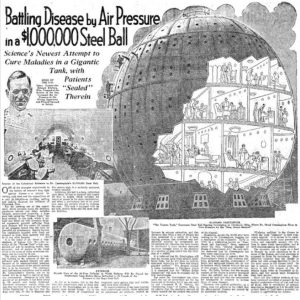 Now we approach the 1900s in the HBOT history timeline. One of the most famous (and LARGEST) chambers is discussed, the Cunningham Ball, by Dr. Cunningham. Dr. Cunningham clearly saw the benefits of Hyperbaric Oxygen Therapy and basically risked his entire career/life, and life savings to help people and prove the benefits. Doctor Cunningham was an anesthesiologist by trade, inventing circuits that are still in use and still patented by anesthesiology. In the 1918s, with the last pandemic of the Spanish Flu, Dr. Cunningham made the observation that there was a higher mortality rate when you went to Denver, as opposed to when you were at sea level, because of the pressure and oxygen changes. Ultimately a Spanish Flu patient in Denver was getting a lower dose of oxygen because of the lower air pressure. Dr. Cunningham even saved the life of one gentleman who was turning blue by simply treating with hyperbaric air. This lead to the dedication of $1M in funds to build the famous Cunningham ball, which was almost like a pressurized six story hotel that people would live in for a month or other extended periods of time.
Apparently, Cunningham had some difficulty justifying it all by scientific standards, and this was a very new concept in US medicine. The world had never seen anything like it! Unfortunately, Cunningham fell victim toa unusual amount of scrutiny, and was eventually shut down with the chamber being sold for scrap metal during World War II.
So many people now see the value in Cunningham’s efforts and what he contributed to the HBOT industry. Finally, his work can be interpreted as vindication of the God-given miracle of oxygen and pressure to heal our bodies and minds.
Guests

Thomas M. Fox, MAS,MS, CHT - Safety Director at Extivita RTP & Research Physiologist for the Hyperbaric Institute for Research and Training
Tom is the Research Physiologist for the Hyperbaric Institute for Research and Training, a division of Island Hyperbaric Centre in Pincourt QC. He has worked in the field of Clinical Hyperbaric Oxygen for the last 30 years. During this time, he has been intimately involved with the implementation and the development of the US Army’s Clinical Hyperbaric Service at Dwight David Eisenhower Army Medical Center. He has provided contract hyperbaric services since 1997. Prior to accepting his current position in Quebec, Canada, Mr. Fox served as the Chief of the Atmospherics Branch of the U.S. Army School of Aviation Medicine, Fort Rucker Alabama. In this capacity, he was responsible for hyperbaric/ hypobaric operations and training of US and NATO aviators, flight surgeons and flight medics. Mr. Fox is a senior army aviator and flew twelve years as a Medical Evacuation Pilot for the US Army.
Tom joined the Extivita team in 2022 as the Safety Director, helping Extivita to maintain a healthy and safe environment for exceptional patient care.
Subscribe Now, It’s Free!
Recent HBOT News
Combining infliximab, anti-MAP and hyperbaric oxygen therapy for resistant fistulizing Crohn’s disease.
Fistulizing Crohn’s disease (CD) presents a therapeutic challenge as fistulae are notoriously difficult to heal. Mycobacterium avium ss paratuberculosis (MAP) treatment in CD is gaining attention. We evaluated healing of CD fistula(e) using a novel combination therapy. Nine consecutive patients who failed to heal fistulae on conventional treatment including anti-TNF, were treated with at least three doses of infliximab, 18-30 courses of hyperbaric oxygen therapy and anti-MAP antibiotics comprising rifabutin, clarithromycin and clofazimine. All patients achieved complete healing of fistulae by 6-28 weeks and follow-up for mean 18 months.
Clinical Trial – Dexmedetomidine Versus Magnesium Sulphate for Caesarean Delivery
Regional anesthesia has become more popular in cesarean deliveries because most of the
parturients prefer being awake during the birth process. In addition, regional anesthesia may
be a safer method than general. In spinal anesthesia local anesthetics alone may not be
enough for an effective postoperative analgesia and hemodynamic stability of the patient wich
is crucial during cesarean section. So far many adjuvants have been used to augment the
analgesia produced by intrathecal local anesthetics and to reduce their adverse effects .
Various intrathecal adjuvants to local anaesthetics have found to improve the quality and
extend duration of spinal block. Prolongation of duration of spinal block is desirable both
for long procedures and for postoperative pain relief. Efficacy and safty of intrathecal
magnesium as analgesic adjuvant has been tested by several clinical trails in recent
years.Antinociceptive effect of magnesium appears to be relevant for the management of
chronic and post operative pain. These effects are primarily based on regulation of calcium
influx in to the cell. Magnesium blocks calcium influx and non competitively antagonizes NMDA
channels. NMDA receptor signelling plays an impartent in determining the duration of acute
pain3).) addition of magnesium to spinal anaesthesia improved postoperative analgesia in
orthopedic setting. addition of intrathecal magnesium sulfate to 10 mg bupivacaine plus 25µg
fentanyl prolonged spinal anaesthesia in patients undergoing lower extremity surgery.
Dexmedetomidine is a highly selective 2-adrenergic agonist which has been used as
pre-medication and as an adjuvant to general anesthesia.Dexmedetomidine have several
beneficial actions during perioperative period. They decrease sympathetic tone with
attenuation of the neuroendocrine and haemodynamic response to anaesthesia and surgery,
reduce anaesthetic and opiod requirement, cause sedation and analgesia. Dexmedetomidine was
first introduced into clinical practice as a short term intravenous sedative in intensive
care. Like any other adjuvant dexmedetomidine is not free from adverse effects. Use of
dexmedetomidine is often associated with a decrease in heart rate and blood
pressure.Dexmedetomidine was used to enhance the analgesic property of local anaesthetics
like lidocaine bupivacaine and ropivacaine. In vivo and in vitro studies indicated that these
local anaesthetics had significant neurotoxicity. Dexmedetomidine showed protective or growth
promoting properties in tissues, including nerve cells from cortex. Intrathecal
dexmedetomidine has a neuroprotective effect similar to methylprednisolone.
The mechanism by which intrathecal alpha 2-adrenergic agonists prolong the motor and sensory
block of local anesthetics is not clear. It may be an additive or synergistic effect
secondary to the different mechanisms of action of local anesthetic and alpha 2 adrenergic
agonist. The local anesthetics act by blocking sodium channels, whereas the alpha 2
adrenergic agonist acts by binding to pre synapyic C fibre and post synaptic dorsal horn
neurons. Intrathecal alpha 2 adrenergic agonist produce analgesia by depressing the realease
of C fibre transmission by hyperpolarization of post synaptic dorsal horn neurons. Li et al
observed that Glutamate is involved in excitatory neurotransmission nociception and plays an
essential role in relaying noxious stimuli in the spinal cord. Intrathecal injection of alpha
2 adrenergic agonists produces potent antinociceptive effects by altering spinal
neurotransmitter release and effectively treats acute pain.
Efficacy of hyperbaric oxygen therapy combined with mild hyperthermia for improving the anti-tumour effects of carboplatin.
Abstract: The aim of this study was to evaluate the effects of hyperbaric oxygen therapy (HBO) on the enhancement of hyperthermic chemosensitisation to carboplatin at mild temperatures in experimental tumours. SCCVII carcinoma in C3H/He mice was used to assess tumour...