
HBOT Conversations:
Join us for interviews with researchers, practitioners, industry experts, and patients to share their stories, successes, and expertise relative to hyperbaric oxygen therapy
Subscribe. Join the discussion. Share the hope.
Listen to or Watch the HBOT Conversations Podcast
Listen to the HBOT Converstations podcast by downloading it from your favorite podcasting platform or scroll down and watch an episode here on the HBOT News website:


Watch the HBOT Conversations Podcast



































Subscribe Now, It’s Free !
Recent HBOT News
Effect of hyperbaric oxygen therapy on chronic neurocognitive deficits of post-traumatic brain injury patients: retrospective analysis.
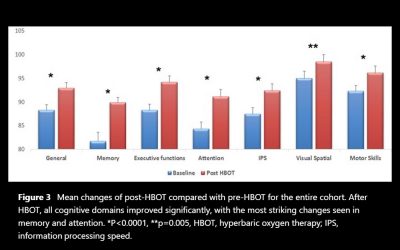
The aim of the study is to evaluate the effect of hyperbaric oxygen therapy (HBOT) in participants suffering from chronic neurological deficits due to traumatic brain injury (TBI) of all severities in the largest cohort evaluated so far with objective cognitive function tests and metabolic brain imaging. A retrospective analysis was conducted of 154 patients suffering from chronic neurocognitive damage due to TBI, who had undergone computerised cognitive evaluations pre-HBOT and post-HBOT treatment. The average age was 42.7-14.6 years, and 58.4% were men. All patients had documented TBI 0.3-33 years (mean 4.6-5.8, median 2.75 years) prior to HBOT. HBOT was associated with significant improvement in all of the cognitive domains, with a mean change in global cognitive scores of 4.6-8.5 (p<0.00001).
Malnutrition screening in outpatients receiving hyperbaric oxygen therapy: an opportunity for improvement?
Outpatients who receive hyperbaric oxygen treatment (HBOT) may represent a group at significant risk of malnutrition owing to the underlying conditions that are often treated with HBOT (e.g., non-healing diabetic wounds and radiation-induced skin injury). In this issue, See and colleagues provide new, preliminary evidence of the prevalence of malnutrition in a small group of HBOT outpatients treated in an Australian hospital, reporting that approximately one-third of patients receiving HBOT were at risk of malnutrition. To our knowledge, routine malnutrition screening is not available in HBOT centres providing outpatient treatment, which may be a key gap in the nutrition care of these patients. Malnutrition screening was developed to identify those at risk of malnutrition across the healthcare continuum.
Addition of Hyperbaric Oxygen Therapy vs Medical Therapy Alone for Idiopathic Sudden Sensorineural Hearing Loss: A Systematic Review and Meta-analysis.
Abstract: Importance Sudden sensorineural hearing loss (SSNHL) causes substantial disease burden for both individuals and socioeconomic aspects. The benefit of hyperbaric oxygen therapy (HBOT) in addition to standard medical therapy (MT) for idiopathic SSNHL has been...