
HBOT Conversations:
Join us for interviews with researchers, practitioners, industry experts, and patients to share their stories, successes, and expertise relative to hyperbaric oxygen therapy
Subscribe. Join the discussion. Share the hope.
Listen to or Watch the HBOT Conversations Podcast
Listen to the HBOT Converstations podcast by downloading it from your favorite podcasting platform or scroll down and watch an episode here on the HBOT News website:


Watch the HBOT Conversations Podcast



































Subscribe Now, It’s Free !
Recent HBOT News

Increasing Veteran’s Access to Hyperbaric Oxygen Treatments
The new MISSION Act, passed by Congress last year, could pave the way for Hyperbaric Oxygen Therapy (HBOT) to be covered by the VA. In general, the act is making better healthcare more easily accessible to veterans. There are a couple of specific clauses, such as the...
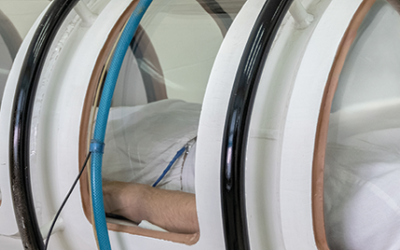
Treatment of Traumatic Brain Injury With Hyperbaric Oxygen Therapy
Hyperbaric oxygen therapy (HBOT) is defined as the use of oxygen at higher than atmospheric pressure for the treatment of underlying disease processes and the diseases they produce. Modern HBOT in which 100% O2 is breathed in a pressurized chamber dates back to the 1930s, when it was first used for treatment of decompression illness in divers. There are currently 13 FDA-approved uses for HBOT, including decompression illness, gas gangrene, air embolism, osteomyelitis, radiation necrosis, and the most recent addition—diabetic ulcers. HBOT can dramatically and permanently improve symptoms of chronic TBI months or even many years after the original head injury. This assertion is generally met with skepticism within the medical establishment because we have been taught for generations that any post-concussion symptoms persisting more than 6 months or so after a head injury are due to permanent brain damage that cannot be repaired.
Clinical Trial – Comparison of Clorotekal and Bupivacaine for Short Obstetric Surgery
The following obstetric procedures are commonly performed with spinal anesthesia on labor and
delivery: bilateral tubal ligation, external cephalic version, cerclage insertion, cerclage
removal, minimally invasive fetal surgery, and evacuation of retained products of conception.
Bupivacaine is currently the standard spinal medication for these procedures because of its
long history of safe use, its low incidence of transient neurologic symptoms, and its ability
to provide a dependable, dense block with a high degree of maternal satisfaction. While
bupivacaine has the aforementioned advantages, it unfortunately has a long duration of
action, up to 240-380 minutes, which far exceeds the time necessary to complete most
obstetric procedures. Clorotekal®, the first Food and Drug Administration approved
chloroprocaine solution created for spinal injection, is a potential alternative. When
compared with bupivacaine spinals, chloroprocaine spinals have been shown to facilitate
clinically significant shorter times to resolution of motor and sensory block, first
ambulation, micturition, and discharge readiness. The objective of this study is to determine
if a strategy of spinal anesthesia with chloroprocaine will reduce the duration of motor
block, compared with equivalent block with hyperbaric bupivacaine..